FEARS DON’T STOP DEATH – THEY STOP LIFE!

The world today is in the grip of ‘FEAR’ and its making people go out of balance a bit.  I thought it will be a great opportunity to reflect on the dimension of ‘fear’ and how it impacts our life.

tonik-hAZ3TNzQP6w-unsplash

Is there something we can do about it? Or Should we?

Self-isolation and social distancing is increasingly giving rise to a feeling of loneliness in people and feeding ‘wild imagination’.  People are imagining the worst for themselves and the world outside.

However, I feel that most of what we fear isn’t going to happen anyway.  Our fears are usually not related to what really happens to us.  Much of what life hands us comes without the prelude of fear and worry.  Our fears don’t stop death, they stop life.  More than we care to admit and more than we even know, our lives are completely devoted to dealing with fear and its effects.  It’s a shadow which blocks everything – love, feelings, happiness and our very be-ing.

When the dangers are unknown and you seemingly imagine that it is lurking around the corner, you will be gripped with fear.  It is like walking in a thick jungle where you constantly are imagining some predator who is out to get you.  It sucks the life out of you.

We give so much energy to the fear factor right from early childhood that we see only fear in the future.  Our culture sells fear.  If you watch TV commercials or programs you will find that almost every 5 minutes reminds you of the dangers lurking around you.  How the food you are eating is dangerous for your health; how the water you drink could kill you; how your jobs can be taken away and the list is endless.  It is fear that keeps selling; so much so that people have become so conscious to the extent of paranoia about what the eat, where they sleep, when they wake up and so on.  But the reality is that what we eat is safe and has got you so far, you will sleep when your body demands of you some rest and you will be awake when you have got enough rest.  Most of the so called ‘fear’ could be the result of your imagination.

Why then do you think Insurance companies confidently bet on the fact that disaster will never happen to us and they earn billions of dollar cause of that.  The point I am making is not that we shouldn’t have insurance, but the fact that we might as well have some fun playing outdoor sports, going on some adventure and seek out to do things which makes us happy.

Yet most of us live as if the odds are stacked up against us.

The point is that we are afraid of many things in life, such as public speaking, asking someone for a date or even admitting we are lonely sometimes.  In many cases we find it easier not to try rather than to be rejected and having to deal with the feelings underneath.

Fears are tricky indeed because they are so well layered, one on top of the other.  You can peel away until you get down to the bottom or foundation on which all others rest.  And that’s usually the fear of death.

For example; suppose you are afraid to ask someone out on a date; beneath that fear is the fear of rejection, and underneath that is the fear that there won’t be someone for you.  Underneath that is the fear that you are not lovable and if you are not loved can you possibly survive?  When people have inadequacies the bottom most fear is “I’m not enough”

If you have been with someone who was dying, you would notice that after a point they no longer have fear.  They prefer to do things which they always wanted to.  Speak or meet someone of their dreams, go out and risk some adventure, not bother about what others think about them.  In my own experience, I’ve seen up close some dear one’s on the verge of dying and they are able to smile more than the care-givers.

If you could literally reach into your fears – every one of them and remove all of them – how different would be your life?  It will help you to see a different life that is possible.

Happiness, anxiety, joy, resentment, we have so many words for the many emotions we experience; but deep down at the core there are only two emotions – Love and Fear.

All positive emotions come from ‘Love’ and all negative emotions come from ‘Fear’.  And mind you, you cannot feel these two emotions at the same time.  They are opposites.  If you are afraid or ‘fearful’ you are not in a place of love.  When you are in space of love you cannot be in the place of fear.

We have to make a decision to be in one place or the other, there is no neutrality.  You have to actively choose ‘love’ over ‘fear’ in order to have a good life.

bram-tXtRVye5oLA-unsplash

You must remember, only ‘Love’ is in the moment and in the present.  ‘Fears’ involve either the past or the future.  ‘Fear’ always has a foundation of the past and causes us to imagine what may happen in the future.

To live in the present, then is to live in ‘LOVE’, not fear.  We can work towards that goal by learning to love ourselves.  Infusing ourselves with love begins to wash away our fears.

Remember, “FEAR STOPS LIFE”!  Make your choice.

POWER – ONE THING YOU CAN’T TAKE AWAY FROM PEOPLE!

One thing people want to keep to themselves and work towards attaining is ‘power’.  Whenever people feel threatened that their power is being taken away from them, they react ever so violently and resist all advances into their territory.

This is applicable in any area of life, your work, relationships, governance et al.

Let me put this in perspective.  In India when the Prime Minister appealed to the nation for one day of self-isolation with a self-imposed curfew, the whole nation followed his advice and made that day a success.  People were requested and not threatened with control.  The request fed into the people’s inherent desire to exercise control over their lives; their choices and they did what was good for them.

miguel-bruna-TzVN0xQhWaQ-unsplash

At the same time when the very next day, control measures were put in place and the government started to pass rules and imposed stringent measures to stop people from moving out, you saw that more number of people defying the orders.  In some places it was just not controllable with hundreds and thousands of people coming out on the streets without any concern of the community spread of the #coronavirus.  What was this, I wondered?  Come to think of it, is it not a way of expressing an inherent desire to exercise power?  Is it their need to still feel in control of their lives?

No one likes being controlled and will resist tooth and nail any attempts to do so.  People despise the act of aggression by others and history has taught them abundant lessons on the negative effects of control; so they are conditioned that way.

So what then is an alternative?  ‘Empower’ is what I feel the way to go.  As on day one of the “People’s Curfew” which empowered people to make their choices, there is a need to create conditions which enables people.  To make their own choice and feel that they are still in control.  Empowering communities, people and families will possibly an effective alternative to government policing, controlling and monitoring.

Yes, it might look dangerous and fraught with the risk of getting out of control and a potential outbreak, but ‘Empowerment’ does come with the risk but the rewards can be manifold.

Remember, people just don’t like their power to be taken away!

It’s a leadership lesson worth learning during this time.

What else can a leader do to ease the pressure during stressful times?

WAS IT REALLY WORTH THE EFFORT?  OF OSTRACISATION DURING THE PANDEMIC!

“Pa I wonder whether it was worth all the effort I put in becoming a Doctor?”  asked my Son.  This came out of the blue and after I saw him pondering with a prolonged silence.

I knew something was hurting and wanted to know what made him say this after over 5 years of hardwork; burning the midnight oil studying medicine; and high levels of stress which go with the profession.

visuals-sVPDoRbSbd4-unsplash

It started with the sight of some of his colleagues being evicted from their rented accommodation and some being asked to vacate the hostels due to fear that as Doctors they may be the carriers of the dreaded Corona Virus.  All of a sudden, the very medical health professionals for whom apparently the whole nation ‘clapped’ were being ‘ostracized’ and it seemed all so ‘hypocritical’ of the society.  He was angry.  “Do you think they really care?  These guys just want a piece of glory by posting their acts of gratitude on social media; that’s it” he said in anger.  How else would you explain such a behavior from property owners.

The news that people were roaming the streets without self-quarantining; those who had a travel history not willing to reveal themselves and get tested; health care professionals being beaten up for traveling to their place of work; hospital informing them that they have to make their own arrangements of ‘safety gear’ like masks, gloves, sanitizers etc. have all been so depressing for him.

A general apathy right around makes him feel that it was not worth all the effort.  The fact that he has to face such idiots who are not willing to follow established protocols makes him angry; and why not?  He should be angry.

What’s the point in blaming the government and the officials who have been pleading with the people to observe social distancing, self-quarantining and safe living practices when such idiots abound.  Coupled with that people who have been hoarding as if there is no tomorrow.  So much so that people have ended up buying all the masks and tissues etc. which would have been of help to the health care professionals who are risking so much for the people.

I feel sad and do not have answers of motivation.  What with evidence pointing to the contrary!

WAS IT REALLY WORTH IT?  I WONDER MYSELF!

What do you think should be my answer?  How do I keep him motivated?

HOW WOULD YOU DEAL WITH “OSTRACISATION” ?

ISOLATION COULD BE THE NEW DISEASE! 

Social distancing is being advocated widely and rightly so, as contact is becoming the single most important factor in the spread of the new ‘Corona-Virus’ disease worldwide.

We need to be prepared for the fall-out.  It’s not just the virus we need to eliminate but also the post-traumatic effects of social distancing and isolation which the quarantined people need to face post recovery.  We are already finding that people are resistant to follow the directives and self-isolate or quarantine.  In India we are still finding effected people travelling, escaping from isolation wards without paying heed to the government and Doctors advice on prevention and cure.

Four people who were stamped for 14 day quarantine by the medical health department had to be de-boarded after they got on to a train full of passengers.  Gripped with fear, people are hoarding and stocks are quickly disappearing from the shelves.  Some don’t want to be seen as the people affected by the new virus therefore avoiding medical checks when showing symptoms.

I was wondering, what is making people behave this way?

Fear from ‘isolation’ and ‘social distancing’ can have its effects on the mind and body. But why is isolation so difficult for humans to withstand?

camilo-jimenez-49h5yXieSSM-unsplash

One of the reasons that living in isolation is difficult is because humans are social creatures. Many people that have lived in isolated environments – such as researchers stationed in Antarctica – report that loneliness can be the most difficult part of the job.

Adventurers who go on solo sailing trips around the world, said that loneliness was what they suffered from most and most difficult to deal with than the elements of nature.

Loneliness can be damaging to both our mental and physical health. Socially isolated people are less able to deal with stressful situations.

They’re also more likely to feel depressed and may have problems processing information. This in turn can lead to difficulties with decision-making and memory storage and recall.

People who are lonely are also more susceptible to illness. Researchers found that a lonely person’s immune system responds differently to fighting viruses, making them more likely to develop an illness.

The impacts of social isolation become worse when people are placed in physically isolating environments. For example, solitary confinement can have negative psychological effects on prisoners – including significant increases in anxiety and panic attacks, increased levels of paranoia, and being less able to think clearly.

Prisoners have reported long-term mental health problems after being held in isolation.

People placed in isolation may also experience hallucinations. The lack of stimuli causes people to attribute their internal thoughts and feelings as occurring in the real world outside of the quarantined environment. They may start to imagine things and start to experience fear and paranoia about the eventualities. However, some people who have been held in social isolation against their will may develop long-term mental health conditions, such as post-traumatic stress disorder (PTSD).

What can we do?

We know that connecting with other humans can reduce loneliness and help restore us to good mental and physical health. Therefore it is important that we not just handle the crisis of the corona virus pandemic medically but also mentally.

  • Providing counseling helpline numbers for self-quarantined people
  • Providing authentic / certified news to people so that they are not misguided in the time of extreme mental stress
  • Providing for mental health professionals alongside Doctors to work with the effected people and hand-hold them along the tough journey
  • Temporary suspension of ‘Group chat’; ‘Forwarding’; on social media apps to avoid spread of misinformation. Any post which uses ‘forward’ button or ‘copy-paste’ must be blocked.  (though this seems extreme but maybe put to use to help the people and the families of those who are going through the quarantine process)
  • Community briefing sessions by medical health professionals on prevention and cure. It cannot be just generic media publicity and then pray that people understand.  Close face to face contact is what will help explain the whole process to the general population.

There could be many more we could think of.  Importantly, let’s gear up for  not just the physical fallout of the pandemic but the mental fall out as well.

I’ve seen some great initiatives by some of my wonderful friends from the network who have used #talktome as a way of helping people who feel isolated at home during the quarantine period.

What are your ideas?  Please share in the comments and let’s help as many as possible. 

Shout out to the Mental health and Medical professionals in my network.

ARE YOU LIVING AN OUTSOURCED LIFE?

If you think that you are making all the choices in your life, think again!

It’s actually our digital devices loaded with complex algorithms via apps which have been monitoring and controlling the way we think, act and feel all the time.  This not just during our waking hours but during our sleep as well.

With health monitoring apps to monitor heart rate, moods, sleep cycles, blood pressure, sugar levels, nutritional intake and more, we seem to have outsourced almost every dimension of our health to the complex network of apps and algorithms.  This to the extent that now it is the app which decides how many steps you got to take to stay healthy or even to live.

stress

Some of these apps have become so intrusive that without realizing you have completely surrendered your life to the digital world.  So much so that they have started to tell you that you are not breathing well and you need to pause all your work and start breathing.  Those who use wearables will know that some of these apps are so proactive that they will suggest your next move in terms of who to speak to, what to eat, when to take rest and so on.

Looks like AI is taking over your world to an extent that the roles seemed to have reversed.  You seem to be operating like the ‘Cyborg’ or ‘robot’ who is controlled by an app controlled remotely by algorithms running on servers miles or even continents away.

The moment you have given permission to or started your life on social platform, you have completely sold yourself or outsourced you life to the digital world. I am sure you would have found it ‘creepy’ at times that your Android phone displays ads about things you were just thinking about or talked to someone about.  Looks like someone is eves dropping on all your conversations and life.  I read the other day that there are wearables which can monitor not just your sleep and dream patterns but also your sex life.  So now an app will tell me when my partner is ready and how much time will it take to get in the mood and gosh what should I do to either prolong the activity or get to an orgasm.  So much so that it will tell each partner using algorithms which analyze the whole sexual activity whether anyone of them was faking it.  It’s not to be brushed aside as you might not be far away from being sucked into this world where you are not the one who decides or chooses but the data in the digital world which does for you.

You will know how much of your life is being controlled by such apps when let’s say one day LinkedIn, Facebook, Twitter or Instagram decides to pull the plug and shut down all the apps and activities.  Imagine the impact on you.  Haven’t we seen a glimpse of these already? When these apps have outages there is so much of frustration and panic worldwide.

If you have let’s say inadvertently kept your location setting on to let people know where you are at any point in time then you would also start getting notifications of friends who are around in that area.  This influences your urge to text them and meet them as well.  So now you see, social media apps will decide who you meet as well.  Apps like Facebook are already known to use powerful algorithms which analyze your personality based on the ‘likes’, ‘comments’, ‘videos’ which you post or share.  They can easily predict what you would like to see and do at any given point in time.  Without you realizing they might be influencing the way you think and act.  In an interconnected world it influences your decisions as well.  For example you liked a post about a product on ‘Facebook’ which your friend apparently shared.  You will find that your Amazon app will display an ad about the same product with maybe exciting offers for you to decide.

Healthcare professionals, business organizations, governments, world bodies et all  use so much of these digital devices and algorithms that now it’s a virtual sell out of life.  You are never in the know of who all have access to your information and for what use it is being put to.

The digital world has consumed the human world slowly and gradually and is virtually taking over our life.  All in the name of helping us make our decisions and enhance the quality of our life.

The fact that people have started to talk about ‘digital de-tox’ goes to show that you are gradually losing the fight to the complex world of digital algorithms.  There is no way out!  You are riding a ‘Tiger’ and getting off is looking more risky.

There is an increasing need for people to be educated on ‘Digital Civics’ at a very early age before they start getting consumed or outsource their life to the Digital World out there.

Have you outsourced your life already?

“Call me if you need any help” – Is it really helpful?

Did you really mean it, when you told someone in distress or going through a tough time “Call me if you need any help”?

I’m sure as well-meaning those offers of help were, deep down in your heart you knew that the person would most likely not call for help.   Asking for and accepting help can be difficult for many and you know that as well. Therefore whenever I hear such an offer, I wonder whether the person really means it.

austin-kehmeier-lyiKExA4zQA-unsplash

I myself wondered at times when I made such offers, though it was intended to provide immediate comfort to the person I worried about the ‘what if’.

“What if?” the person really called asking for help.  Do I have the time or the bandwidth to help?  Did I jump the gun and offer for help without realizing that it was possible that the person would really call?  There were also times when people did call back asking for help and I was not in a position to help them.  I did feel like an idiot.  Why did I in the first place make an offer which I couldn’t follow through?

At times we are also not sure whether it is appropriate to offer help to people.  What if the person concerned is not looking for our help?  Maybe I’ll offend the person by presuming that the person needs help?

This happens in organizations as well.  Managers tell team members that they can call them any time they need help and when they do get such a call for help, they start to give excuses about lack of time etc.  This really impacts the credibility.

I’ve had several instances when I took the offer of help by someone seriously and when I called them, they started to avoid or give excuses.  I felt like an idiot having believed this person; and at times insulted or hurt.

I realized that often times the offer “call me if you need anything” doesn’t work for either side.  It’s best as the famous Nike line goes “Just do it”

I remembered one such offer my friend made, which I think was fantastic and really touched me.  This was when I was down with severe sciatic pain and was immobilized for almost a week.  He called me and said “Hey I am at the nearby store running some errands, do you want me to pick up something and drop it for you on the way?”

It made me feel very comfortable.  As a seeker I didn’t feel that I would be bothering my friend much as he was already at the store.  The fact that he would drop by on the way back home was also comforting as I didn’t have to upset his schedule.

I got another one during this period.  It went like this “Hey, I am bringing Friday dinner, what would you like to have, some noodles or lasagna?”

We don’t have to sound hollow in our offer for help.  If you truly wish to help, just do it!

What kind of specific offers of help stood out for you as a person?

Do you appear as if you give a damn? – ‘Empathy pitfalls’ and the practice of CPR©

“Don’t’ worry my boy, you are not the first, I’ve seen lots of people naked in the last 25 years” said the Doctor to my son when he was taken in for examination.

The Doctor failed to realize here that it was not about him, it was about my son’s discomfort of lying naked in front of a stranger.  While it was an attempt to reassure the patient, it lacked ‘empathy’.  In fact my son’s angry response “You might have seen many naked but I am not comfortable” put things in perspective.

“Don’t worry”; “Everything will be all right”; “It can’t be that bad”; “Like everything this one too will Passover”; “just be positive”….

Have you heard this from someone before?

Do you often rush to reassure people when they tell you their distressing stories or share their pain?

empathy

In a relationship where decisiveness and action is often valued, it is difficult not to do something to defuse others distress when it occurs. Such reassuring statements are usually made in good faith and sometimes may be probably true: that is, it is likely that everything will be all right.

Nonetheless, you would have experienced yourself that such reassurances often fail if it does not communicate an awareness of your situation.  You will agree one of the most widespread and persistent complaints today is that people don’t ‘listen’.  They blame it on being pressured for time, being preoccupied with handling their own problems, pressure to deliver results and so on….  Plenty of excuses on offer.

How many times you would have heard the following as responses to your reassurances?  “You don’t seem to understand my predicament”; “it’s easy for you to say it can’t be that bad”; “how do you expect me to be positive in such a situation”; “it’s not happening to you so you can say whatever”

All these responses are an indication that you have failed to demonstrate empathy.  An understanding of the person’s situation, perspective and feelings and to communicate that understanding back to the person.

Many times when we are confronted with distressful stories of people, we do not know how to listen empathetically.  In our anxiety to help we jump the gun and aggravate the pain further by offering reassurances which demonstrate lack of understanding.  Almost always having an adverse effect.

What do you think might work?  How can you demonstrate empathy?

I feel the CPR© (Clarify, Probe, Respond) method helps in this case.

Clarify – queries which will encourage the person to talk more about the distressing story;

  •  “Would you tell me a little more about that”
  • “What has this been like for you?”
  • “Is there anything else?”

Probe – to check if you have a clear understanding by using statements like;

  • “Let me see if I have got this right.”
  • “I want to make sure I really understand what you’re telling me.”
  • “I don’t want us to go further unless I’m sure I’ve got this right.”
  • “Please correct me if I don’t get it right, okay?”

Respond – to reaffirm and communicate your understanding of the whole situation

  • “That sounds very difficult.”
  • “I can imagine that this might feel . . .”
  • “Anyone in your situation would feel that way . . .”
  • “I can see that you are . . .”

A pause while practicing CPR© goes a long way in demonstrating empathy.  It helps others experience being understood

Too often, we hear only what we want to hear, and discount what we consider irrelevant.

What is the most ‘empathic response’ you have heard?  Add to the list..

© thecriticaldialogue.com

Would you like to play ‘God’?  Why not start with someone you love?

Why not play ‘God’ to people who you really want to help?

My prayer is my conversation with ‘God’ in which I derive the maximum comfort as well as maximum strength.  It’s cause the so called ‘God’ is an entity who;

  1. Listens to me without filters
  2. Doesn’t judge me
  3. Doesn’t react to my angry outbursts
  4. I can complain to without being interrupted
  5. ben-white-ReEqHw2GyeI-unsplashWill not ridicule me for crying
  6. Will not label me
  7. Has infinite patience
  8. Does not punish or reprimand me for what I say
  9. Allows me to be just me
  10. Leaves me to make my choices

It’s now a cliché’ when you hear statements like “God help those who help themselves”  How true?

Come to think of it, this statement has deep meaning.  How does God help you?  ‘It’ (I am using ‘it’ to describe this entity as I do not for sure know ‘its’ gender) helps you by following the 10 commandments above.  In fact ‘God’ is a master facilitator.  Without being prescriptive ‘it’ guides you to make your own choices and therefore builds greater ownership and accountability.  It’s that which helps us gain clarity and succeed in life.

You can play ‘God’ to someone you love or who you work with  and help facilitate their growth by being ‘it’ and sticking to the 10 commandments of godliness which I’ve learnt from my years of prayer practice and meditation.

I’ve observed that most interpersonal relationship problems occur because we are not able to bring out the ‘God’ in us.  We either become judgmental, reactive, prescriptive, violent and start to make choices for others which kills the relationship.  Instead we can all practice these 10 behaviors.

Would you like to play ‘God’?  Why not start with someone you love?

© thecriticaldialogue.com

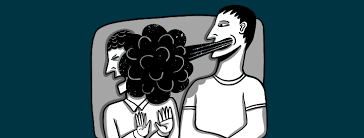
Are you a ‘trash can’ for others toxic behaviors?

“My boss sent my wife a friend request on Facebook with a personal message and she didn’t take kindly to that behavior.  She blocked him promptly and wants me to confront him on this” said Sam (name changed) an employee in a client organization.  She’s been asking me everyday whether I did what she asked me to do i.e, confront my boss.  When I say that I will do it at an appropriate time, she gets angry and starts alleging that I am not showing enough concern and not able to protect her.  This is draining me emotionally and I am dreading the thought of facing her back home everyday.

toxic people

“Why don’t you just tell your boss about his unacceptable behavior?” I asked.  Don’t you think it is important to confront him immediately before your relationships starts to stink from accumulated trash from both ends?

I really want to confront him about it, but am afraid he will be upset and that will effect my work and relationship with him.  He is a nice guy and has been extending lot of support to me and helping me grow, said Sam.

Are you feeling good about this whole situation? I asked Sam. Isn’t it draining you emotionally when you have been accumulating this trash on a daily basis?  Don’t you think you must clear your emotional trash can before the stench of it starts to spread to all your relationships?

I really want to but do not know how? Said Sam.

Sam’s is not an isolated case.  We find that people are living, walking, talking “emotional trash cans” without even realizing that its filling up fast and would then start to affect the mental health as well as relationships.

I remember one such incident which taught me why it is important to shed your “emotional trash” before it becomes toxic for you.  It was at the airport and here was a guy who jumped the queue and went straight ahead to the front acting as if he has not seen people waiting their turn.  I was angry and instead of telling that guy to get back in line, I started to discuss with my partner who was with me about how even the educated do not have the civility to behave in public spaces.  I continued my internal dialogue “how do this people even get this far?”  “what’s happening to the world?”  “Why do people behave this way?” and many more.  It just spoilt my mood and the trash of this transaction carried forward for the entire flight as well.  I was getting irritated by the slightest of noise from a child who was 4 rows away and in a playful mood.  I was angry at the flight attendant not coming soon enough to serve me my pre-booked meal which I blamed on poor service attitude.  I was not happy with fact that a fellow passenger was snoring and some were talking loudly disturbing my peace.

I must say, by the time I landed, I was filled with a lot of emotional trash and it had started to emanate stench outside of me – in my transactions.  It was just a matter of telling the guy who cut the queue to get back in line.  It was my right and as much as the right of all others who were in queue.  I am sure if I had pointed that out to him, he would have complied, even if reluctantly or sheepishly so.  But I chose to keep the trash of that man’s toxic behavior inside me.

So many of us go about our day accumulating ‘trash’ from the toxic or negative behaviors of others and fail to clear and carry them to bed instead.  Garbage accumulated over many days starts to impact our transactions with the outside world.  That’s the reason why when relationships go bad we say “my relationship stinks”.

Sam was waiting for the opportune time and in the meanwhile building up his own stories about how his boss wouldn’t have had a bad intent, how his wife was over reacting, how it might effect his relationship with boss, how he could even lose his job for leveling allegations against his boss and so on….  It was already starting to effect his relationship both in office and at home.  In office, he started to see his boss’s overly friendly nature towards him with suspicion and with a hidden agenda.  At home he was fighting with his wife over not confronting his boss.

I told Sam “If you are really honest with yourself, you will find it’s worth it – that you are better off than being a trash can for others negative behaviors”.  It’s important that you clear ‘trash’ regularly as you would do to the physical garbage at home.

So many of us would have faced such behaviors.  Lewd comments, suggestive texts, crass jokes, sexist jibes, adding us to groups without prior approval and so on….

Many choose to let it pass without realizing that it is that little bit of garbage which will eventually pile up to become a toxic dump of negative emotions.

How do you think Sam should approach this?  How would you deal with this?  How should Sam articulate his ‘critical feedback’ to his boss?

©thecriticaldialogue.com

Disclaimer: All characters appearing in this work are fictitious. Any resemblance to real persons, living or dead, is purely coincidental.

When a ‘critical conversation’ turns nasty!

The more you care about an issue – the critical dialogue of ‘feedback’

“Your son is no good,  I don’t think he will pass”  said my son’s math teacher to my wife and that too in front of the whole class.  This incident I recall happened when he was in 9th grade.  My wife had gone to school concerned that our son was losing both interest and confidence in math.  She thought it will be a great idea to discuss with his teacher and understand what exactly was going wrong.

Now the teacher’s statement brought her to a boil as this dialogue turned critical.  She was furious and hit back with great force.  “I think you are no good as a teacher.  You don’t know how to teach and are blaming the kids for your failure.  I wonder how you even became a teacher.  You don’t deserve to teach”.

frank-busch-4aqYzVwTpG0-unsplash

She came back home furious and at the same time feeling victorious that she could hit back and hurt the teacher more than what the teacher had caused to our son.

When she came back and narrated this incident to me, I could sense that her emotions had gotten the better of her and she forgot in the process to find out the real problem my son was facing in school.  I didn’t blame her for that though, as I understood that our son’s academic progress was an issue very dear to her.

She wanted me to accompany her the next day and confront this rogue teacher as she would like to call her and give her a piece of my mind as well.  It was almost like she was goading me to hit with greater force.  I realized that the whole transaction was becoming unsafe for all parties.  A simple ‘feedback giving and receiving’ process had turned ugly.  People had started to pass judgments and conclusions instead of working with facts.  It was ‘the critical dialogue’ which I thought would give an opportunity to clear the air and get the whole process to a meaningful conversation.  I’ve been teaching ‘feedback’ process in organizations and felt that it is such a wonderful skill to improve the quality of any interpersonal relationship.  Wanted to give a shot.  Here is what I did.

Collection of facts – I asked my son as to what makes him hate math?  What was happening to him at school?  And so on.  I understood that it was not ‘math’ per se which was his problem.  His issue was with the teacher, who used to blame students in front of the whole class and pass judgments which hurt students quite a bit.  Some students chose to keep quite but my son preferred to discuss it with us and wanted to resolve it as well.  He wanted us to tell his teacher to stop criticizing him and other students in front of the whole class.  Here was an opportunity to provide feedback to the teacher concerned.

I made it the next day and this is how the conversation flowed.

Making it safe for the ‘feedback receiver’  “When I first heard your opinion about my son, my initial reaction was of anger and I really wanted to hit out and oppose you.  But after thinking about it, I’ve realized that there is more I can learn from you about my son’s progress.  I know that you care a great deal about my son and I’m confident you are well-trained.  I know you want to do best for my son and I do too. I have some fears and concerns which I feel will have huge implications for him in the future. Is it ok if I share that with you and we could together look at it objectively?

This created an environment of safety for the teacher to reply “I really feel that he has great potential and even I would want him to do well”

You notice that ‘the critical dialogue’ has turned towards a meaningful conversation the moment I created a safe environment.

The next steps are pretty straight forward in ‘giving  feedback’.

Step 1: State the facts (they can’t be denied)  “I observed that you have been critical of my son in front of the whole class”

Step 2: State the impact (results of such actions / behaviors) “He is unable to concentrate in the class due to the constant fear of being reprimanded in front of the whole class”

Step 3: State the feeling (good/bad/happy/unhappy) “I am feeling concerned about how this is impacting his self-esteem”

Step 4: State what your expectations are “I would have expected that you had a private 1:1 conversation with my son to give him your critical feedback.  Is it ok for me to expect this from you? (talking tentatively will keep the conversation in the ‘safe zone’).  It’s my son’s expectation too.

Interesting fact I learnt:  The teacher was of the opinion that if she criticized my son in front of the whole class, he would be angry and motivated to better.  Now I knew where she was coming from.

Step 5: Use ‘opinion’ instead of advice “In my opinion a 1:1 would have made it easier for him to accept your valuable feedback” (an opinion is easier for people to digest as they feel less threatened and also know that as much as you have your opinion, they would too.)

Happy ending the concerned teacher accepted the feedback and agreed that she was probably wrong in assuming that all students would respond to her techniques in the same way.  She promised to have more 1:1 with my son and help him progress.

This critical dialogue went a long way, so much so that my son not just started to like math but did well to get a perfect score in his boards and a national merit certificate for his performance in math.

When we care for an issue or feel strongly about the subject, we might not be able to demonstrate our best behavior.

We;

  • Tend to sulk
  • Get angry and violent
  • We become pushy and hurt others
  • Start to exaggerate our stories
  • Make villains of others
  • Violate their rights
  • Stop listening
  • Retaliate
  • Insult
  • Become sarcastic
  • Become judgmental

If we can step out of ourselves and start to have a dialogue only based on facts, it becomes so much easier for any ‘critical dialogue’ to become meaningful.

There are so many situations where we have the need to use ‘feedback’ as part of a critical dialogue process.  In office, with spouse, with children, colleagues and many more.  If we can use the steps as I have outlined above, we might have a chance.